Silent extraction: how to choose the right extractor fan for your grow room before the season starts
14 September 2026

Airflow first, everything else after
Before you look at decibels or power consumption, you need to know how much air you have to move. In indoor growing, the baseline rule is to fully replace the air volume of the space every minute:
Airflow (m³/h) = length × width × height (m³) × 60
A 3 × 2 × 2.5 m room is 15 m³, which works out to roughly 900 m³/h as a starting point. On top of that figure you need to add the real pressure losses of the installation:
- Carbon filter: roughly 25% more airflow. A filter should always be oversized relative to the extractor fan, never the other way round.
- Ducting and bends: every metre of flexible ducting and every change of direction slows the air down. With long runs or several bends, allow for another 10-20%.
- Silencers and grilles: they add resistance; it's worth leaving some margin.
With those corrections, that 15 m³ room calls for a unit capable of delivering somewhere around 1,200-1,300 m³/h. And here's the key to noise: an extractor fan running at 60% of its capacity is much quieter than one running flat out all day. Choosing with margin isn't overspending, it's buying silence.
Why an EC motor changes your electricity bill
Electronically commutated (EC) motors don't regulate speed by throttling current, the way classic AC motors do: they adjust the revolutions electronically. That means when the fan runs at 60%, it consumes roughly in proportion, instead of drawing almost the same current and dissipating the rest as heat and vibration.
In an installation running twelve hours a day throughout the season, that difference shows up on the bill, and in the equipment's working life: less heat, less vibration, less mechanical fatigue.
Where the noise actually comes from
The decibel rating on the spec sheet is only part of the problem. In a real installation, noise has three sources:
- Aerodynamic: turbulence as air passes through tight bends, sudden reductions or grilles. Fixed with wide curves and consistent diameters.
- Mechanical: motor vibration transmitted to the structure. Fixed with anti-vibration mounts and avoiding rigid contact with walls and ceilings.
- Operating point: the unit working flat out. Fixed by choosing with margin and regulating speed.
The EC Silence Inline Fan range
Our EC Silence Inline Fan extractors are built exactly for that scenario: moving a lot of air without turning the room into a wind tunnel.
- Diameters: 200, 250 and 315 mm.
- Airflow: from 1,310 to 3,500 m³/h depending on model.
- Noise level: from 59 to 70 dB depending on model, at rated speed.
- Low-consumption EC motor with 0-10 V control.
- Cold-rolled steel housing with overvoltage protection and mounting brackets included.
0-10 V control is the piece most installations leave out. Without it, the fan only knows on or off. With it, it can run at 50% overnight and ramp up on demand when temperature or humidity call for it.

The complete system: fan, filter and control
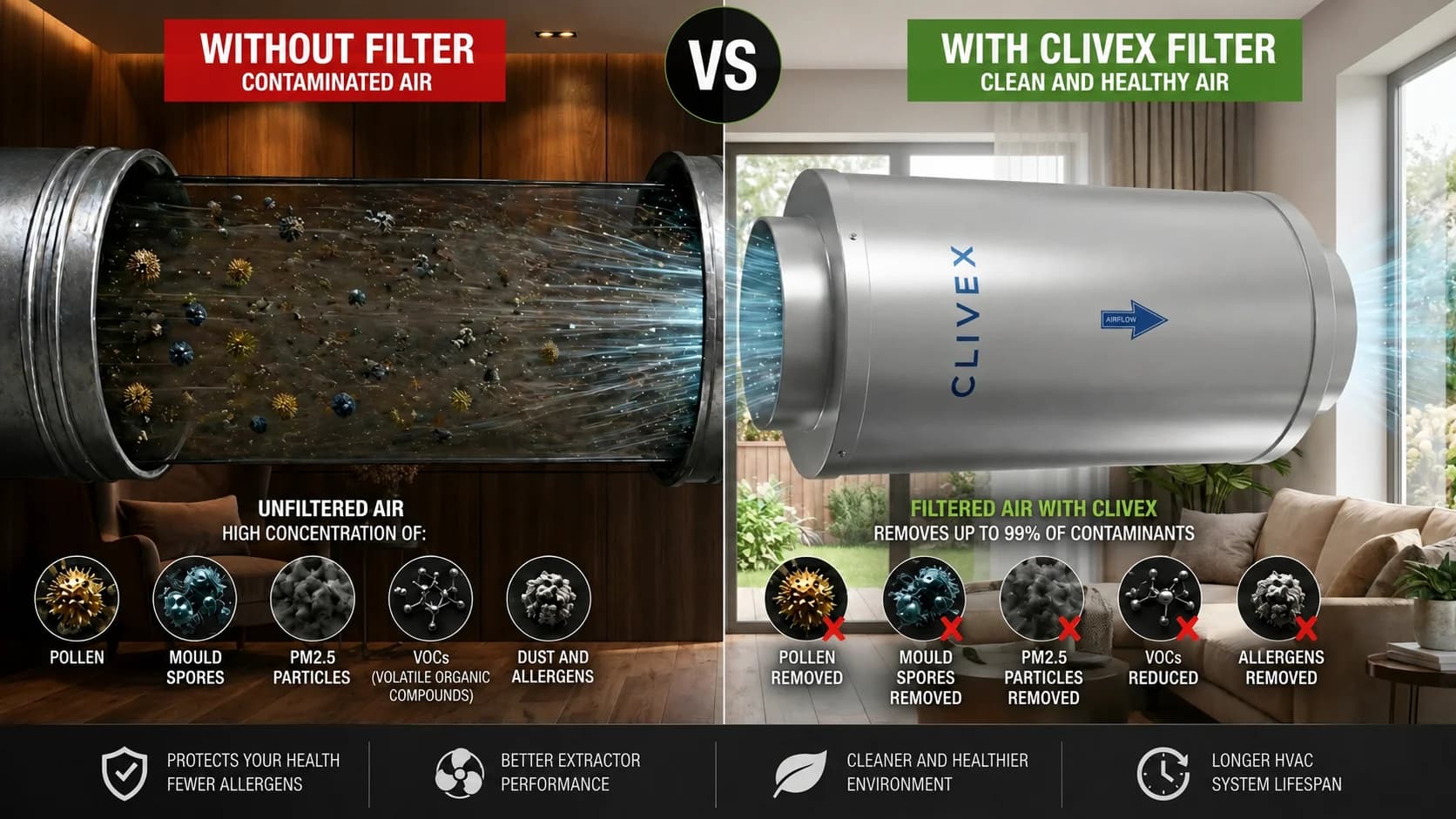
A quiet extractor fan connected to an undersized filter stops being quiet, because it has to force the air through. That's why the combination we recommend is:
- Extractor EC Silence Inline Fan in the diameter your airflow calculation calls for.
- Filtro de carbón In-Line 250 mm, up to 3,300 m³/h, high-density activated carbon with bidirectional flow. It fits inside the ducting itself, so it doesn't take up space in the room.
- Controlador digital Wifi 0-10 V, with temperature and humidity probe, LCD screen with real-time RPM, and AUTO, manual and timer modes. Controlled from your phone with the Tuya Smart app.
With all three elements, the system stops being a fan wired to a tube and becomes an installation that adjusts itself.
Checklist before you install
✔️ Calculate the airflow and add the filter, ducting and bends. ✔️ Choose equipment to run at around 60-70% of its capacity. ✔️ Fit a filter that's oversized relative to the extractor, never the other way round. ✔️ Use wide curves and avoid sudden reductions in diameter. ✔️ Decouple the unit from the structure with anti-vibration mounts. ✔️ Install 0-10 V control from day one: it's what turns power into silence.
Need help sizing an installation?
The CLIVEX technical team can help you calculate airflow and choose the right combination of extractor, filter and control. And if you run a shop or distribute growing equipment, get in touch: info@clivex.com